 Every year brings books that impress us with their ambition, storytelling, or ability to transport readers somewhere new. Occasionally, a book does something more difficult, finding a way to make an emotion feel like a place.
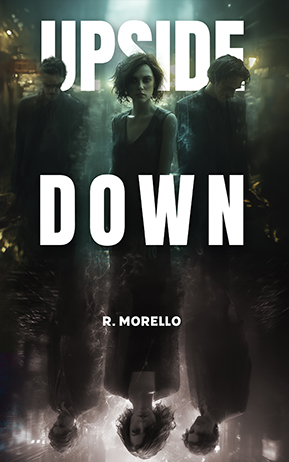
That is what R. Morello accomplishes in “Upside Down”, and it is why we selected it as our 2025 Book of the Year.
“Upside Down” takes grief, emotional isolation, buried trauma, and the divisions people create within themselves and transforms them into a speculative reality that feels both completely unfamiliar and immediately recognizable.
The result is one of the most unique and emotionally affecting books we encountered in 2025.
A Premise That Is More Than a Premise
The central idea behind “Upside Down” is striking on its own.
Following the death of his sister, Caleb experiences a fracture in reality. There is the world people inhabit every day, and beneath it is something else. An inverted existence in which the emotions people suppress above are no longer so easily hidden.
The speculative element becomes a metaphor that the reader actually experiences.
People can continue functioning while carrying enormous grief. They can have conversations, go through routines, distance themselves from people they once loved, and appear outwardly intact while another part of them is anything but.
“Upside Down” gives that contradiction a physical form.
It is a remarkably simple idea once understood, yet we could not think of another book that approached emotional fracture in this way at all.
The World Works According to Emotion
One of the most impressive aspects of “Upside Down” is that its rules are emotional.
The relationship between the world above and the world below reflects the frustrating reality that understanding what is wrong with someone does not necessarily give you the power to change them.
That distinction gives the book an unusual authenticity.
Morello does not treat healing as a switch that can be flipped once a character recognizes the source of the pain. They misunderstand one another and protect themselves. They carry old wounds into new relationships. Sometimes they desperately want another person to make a different choice and discover that wanting it is not enough.
The speculative mechanics reinforce those ideas. The world is the psychology of the story.
An Unusually Vulnerable Approach to Grief
Grief is common territory in fiction. Caleb’s loss is the doorway into the story, but the book gradually widens its focus. There is grief for relationships, for families, for versions of ourselves that disappeared, and for things that can never be repaired exactly as they once were.
There are moments in “Upside Down” when very little needs to happen externally because the emotional implication of what is happening is enough. A conversation, a separation between two people, or the inability to reach someone can carry as much weight as a conventional action sequence.
The book trusts the reader to understand those moments.
It rarely stops to explain what the reader should feel.
It creates the situation and allows the feeling to arrive on its own.
Characters Without Their Armor
Perhaps the most affecting idea in the novella is the contrast between the selves people present to the world and the emotions they carry underneath.
Most people learn how to function.
They learn how to say they are fine. They become angry instead of frightened, distant instead of hurt, indifferent instead of vulnerable. Eventually, the protective version of a person can become the version everyone else believes is real.
The book’s inverted reality allows Morello to explore without turning it into a lecture about trauma. We encounter people whose outward behavior and internal emotional lives can be radically different, and the contrast changes how we understand them.
It also creates some of the book’s most painful moments.
A person can love someone and still be unable to reach them.
Someone can understand another person’s pain and still be unable to repair it.
Two people can carry feelings for one another while the versions of themselves capable of expressing those feelings seem impossibly far apart.
Those are recognizable human experiences placed inside an entirely unfamiliar framework.
That combination is where “Upside Down” becomes exceptional.
A Book That Does Not Over Explain Itself
Another reason “Upside Down” stood apart was Morello’s restraint.
Speculative fiction frequently devotes enormous space to explaining how an invented world works.
The reader discovers its reality along with Caleb.
Some things become clearer. Others remain unsettling.
That uncertainty is important because Caleb himself does not possess a convenient instruction manual for what is happening to him. The reader shares his disorientation, gradually recognizing patterns and understanding that the strange geography around him is connected to something human.
The approach makes the book uniquely immersive. The reader is placed inside it.
Short Enough to Read Quickly, Difficult to Leave Behind
At just over one hundred pages, “Upside Down” can be read in a few sittings. Its emotional effect lasts considerably longer.
There is very little excess in the story. Images and ideas recur until they begin to feel less like pieces of world building and more like a vocabulary for emotions that are difficult to describe directly.
That is one of the greatest compliments we can give the book.
After reading “Upside Down”, its central metaphor is difficult to forget.
It becomes surprisingly easy to imagine the people we encounter every day carrying an unseen counterpart containing everything they have learned not to show.
And once a story changes the way a reader thinks about something outside the story, it has accomplished something significant.
Darkness Without Hopelessness
“Upside Down” is unquestionably a dark book.
It deals with death, trauma, damaged relationships, emotional isolation, and the ways suffering can change people. The book’s interest is in what people do with it.
Pain can be confronted or avoided. It can create empathy or cruelty. It can connect people who recognize it in one another, or isolate someone who refuses to face it.
Most importantly, healing in “Upside Down” does not mean erasing what happened.
It means becoming capable of carrying it differently.
That distinction prevents the story’s hopeful moments from feeling artificial. There are no easy emotional resets. What has happened still matters. Hope exists anyway.
Why “Upside Down” Is Our Book of the Year
Choosing a Book of the Year ultimately comes down to a book we remember.
The book that gave us something we had not encountered before.
The book whose ideas continued to surface after the final page.
For us, this was that book.
R. Morello created an original speculative world with a purpose behind it.
The inverted reality gives physical form to something almost everyone understands. The enormous distance that can exist between how a person appears and what that person is actually carrying.
It turns grief into geography, emotional suppression into speculative fiction, and division between the person the world sees and the person underneath into a place the reader can enter.
It finds room for grief, love, regret, fear, trauma, connection, and the possibility of becoming whole without pretending that becoming whole means becoming untouched.
No other book gave us quite the experience that “Upside Down” did.
For its originality, emotional fearlessness, and unforgettable transformation of internal pain into an external world, “Upside Down” by R. Morello is the Authors Unleashed 2025 Book of the Year.